How We Build Bespoke Software (And What Drives the Cost)
TL;DR
We build bespoke software in three phases: discovery, a paid discovery proposal, then agile delivery.
The discovery proposal is a fixed, one-off fee. If you go ahead with the build, it comes off the project cost.
You see working software at the end of every sprint, so there is no black box and no spec you are locked into on day one.
There is no single price for bespoke work. Scope, integrations, data and how much AI is involved are what move it.
We act as product owner, scrum master and the development team, so you steer the direction without having to run the project.
Bespoke software scares people, and for good reasons. The usual story is a big bill, a finish line that keeps moving, and a team who talk over your head. We built our process to take each of those off the table. So here is exactly how a project runs with us, and what makes it cost what it costs.
The Three Phases
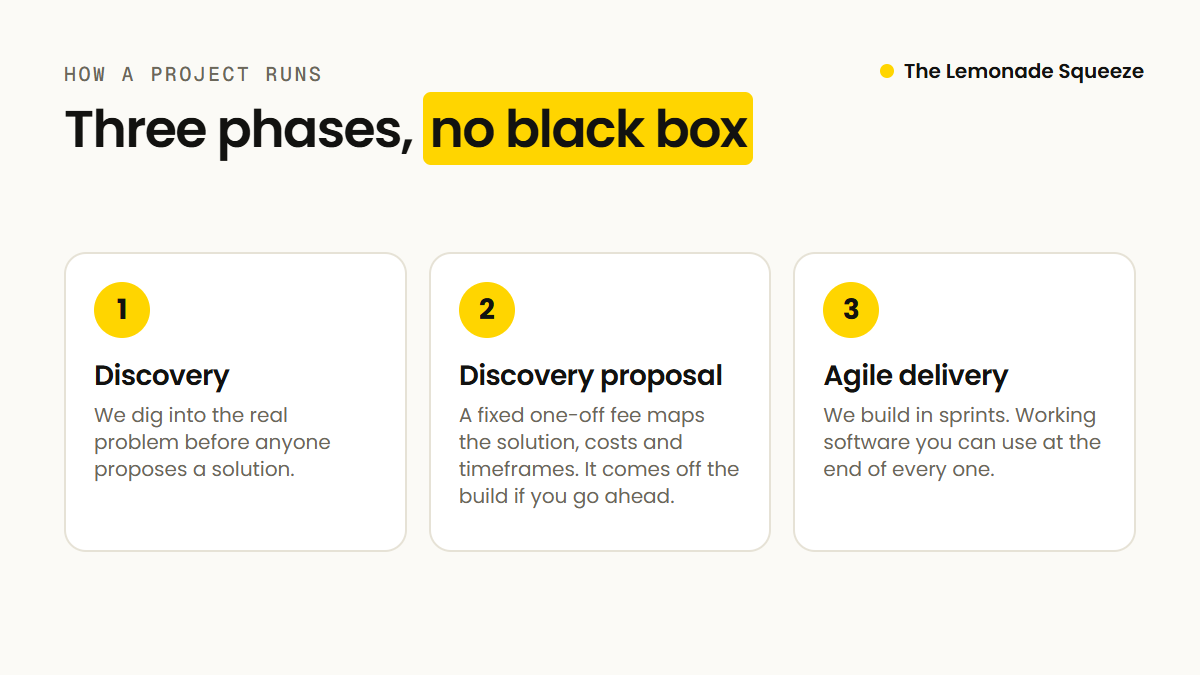
Every project moves through the same three steps. The shape is deliberate: each one answers a worry that stops business owners committing to custom software in the first place.
Discovery. We dig into the problem before we propose anything. What is actually going wrong, how your business runs, where the real friction is. No solution gets drawn up until we genuinely understand the challenge. Skipping this is how projects end up solving the wrong thing.
The discovery proposal. We map the solution, the likely costs and the timeframes, and hand it over for a fixed one-off fee. If you decide to go ahead, that fee comes off the build. So you are never paying to find out what something will cost and then paying all over again to have it made.
Agile delivery. We build in sprints. Every sprint ends with a review, a demo and a release of working software you can actually use. The backlog can be reshuffled at any point, so you are not married to a specification someone wrote on day one before anyone had learned anything.
What Drives the Cost
The honest answer is that there is no single price. Anyone who quotes a bespoke build before they understand the problem is guessing, and a guess that low usually grows later. That is the money pit everyone is afraid of.
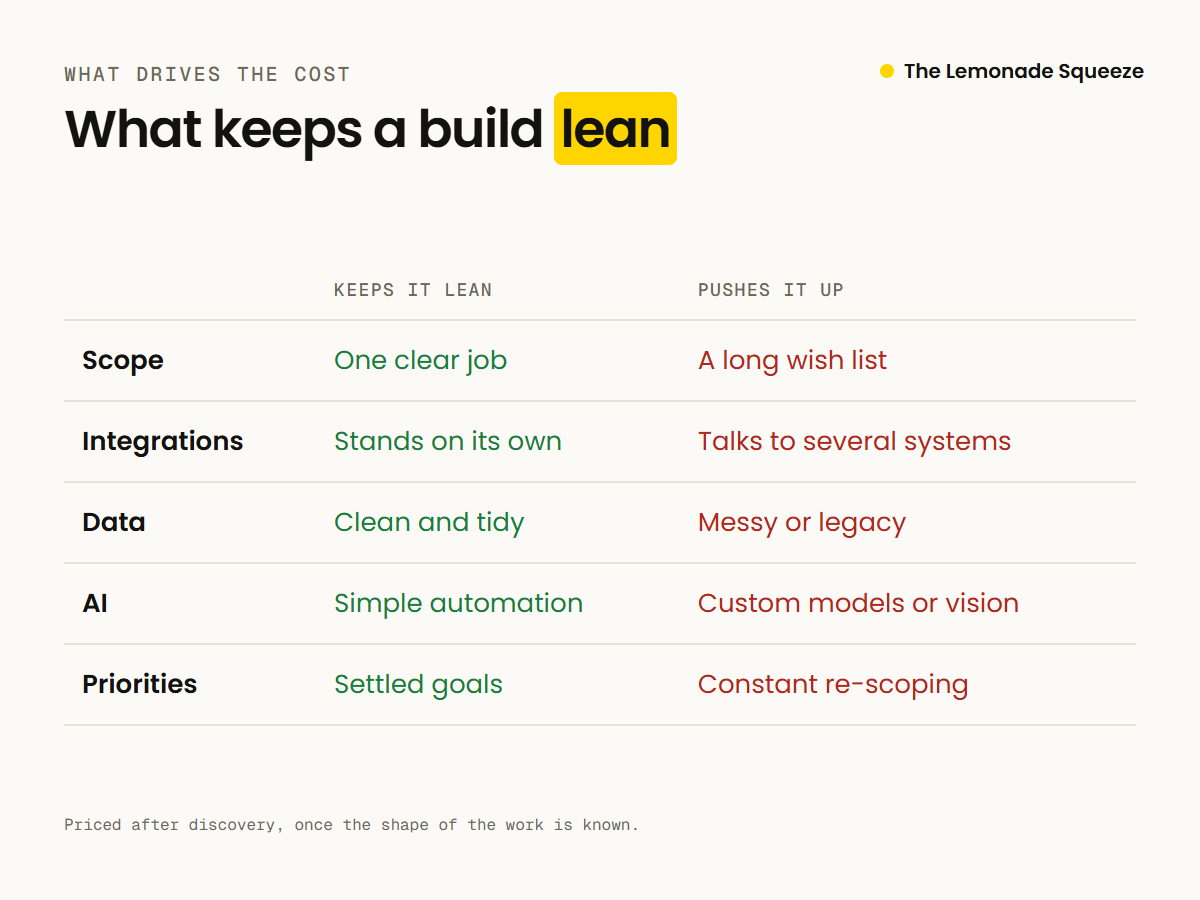
We price each project after discovery, not before. Once we know the shape of the work, a few things decide where it lands.
Scope. One clear job costs far less than a wish list tackled all at once.
Integrations. Software that stands on its own is simpler than something that has to talk to your CRM, your accounts and your booking system.
Data. Clean, tidy data is quick to work with. Messy or legacy data takes time to untangle first.
How much AI is involved. A simple automation is one thing. Custom models, computer vision or language work are another.
How settled your priorities are. Steady goals keep a build lean. Constant re-scoping adds sprints.
The point of the discovery proposal is that you see these numbers before you commit a penny to the build. Clear goals, a clear budget and a clear endpoint, agreed up front. No nasty surprises.
What You Actually See Along the Way
The thing most people have been burned by is the black box: you pay, you wait, and you have no idea what is happening until something lands that is not quite what you meant. We work the opposite way. Working software at the end of every sprint means you are steering the whole time, not hoping at the end.
With most agencies you end up filling the project manager role yourself, chasing updates and making the calls you are not equipped to make. We act as product owner, scrum master and the development team. You show up, give feedback and point us in the right direction. We carry the process, you steer the direction.
A mid-sized business came to us stuck with an old booking system they could not get useful data out of. Other suppliers had told them it was impossible without a huge, expensive overhaul. We listened, worked out what they actually needed, and built a lightweight connector that pulled their booking data into one simple dashboard. There was no big system change. For the first time they could see their bookings and follow up with customers. They called it a breath of fresh air after months of confusion.
Agile Delivery
The old way - you pay upfront, wait 12 months for the software to be delivered only to find requirements we mis-interpreted or your business has changed since the project was started and the software no longer fits.
The Happy Lemon Labs way - agile planning and delivery. The project is broken down into smaller, deliverable chunks, usually around individual features. The list of features is prioritised (by you).
We work in sprints of 2 - 3 weeks, at the end of each sprint, a set of features is delivered for your review.
We then review the next set of features with you, confirm requirements are still valid and get to work.
This means you are involved in the process, you get to steer the projects direction AND get to see updates regularly. Anything outside of the 2 - 3 week sprint can be changed / removed / added / re ordered.
This enables a flexible project that works for your business!
Who It Is Not For
Bespoke is not always the right answer, and we will tell you when it is not.
If an off-the-shelf tool already does the job, buy that. If a simple automation through something like Zapier or Make solves it, start there, it is cheaper and faster. Custom software earns its cost when your way of working is genuinely unusual, when the tools that exist force you into their shape, or when the manual workaround is quietly costing you more every month than a build would.
Two other honest notes. If you want a fixed price before anyone has understood the problem, we are not the quickest route, because we do discovery first on purpose. And if you already have a full in-house tech team and just need extra hands, our carry-the-whole-process model is less of a fit than it is for an owner with nobody in those seats.
If you have ever been told your system is too old or too complicated to improve, that is usually the moment worth a second opinion. 🍋