Is It Legal to Ask Customers for Google Reviews in the UK?
TL;DR
Yes. Asking customers for a Google review is legal in the UK, and nobody is cracking down on the asking itself.
The Digital Markets, Competition and Consumers Act 2024 (DMCC Act), in force since 6 April 2025, bans fake reviews and reviews with a hidden incentive, not genuine requests.
Paying for a review, or only asking customers you know are happy, both break the rules.
Google has its own ban on "review gating": screening customers first and sending only the satisfied ones to leave a review.
The safe approach is one neutral ask, sent to every customer the same way, with nothing offered in return.
Yes, it's legal, and it's actively encouraged. The confusion comes from mixing up two separate rulebooks: UK consumer law, which cares about honesty, and Google's own platform policy, which cares about fairness. Follow both and there's nothing to worry about.
Most business owners never read either rulebook. They just notice a competitor with 90 reviews, start asking customers themselves, and then worry they've done something wrong. You haven't, as long as the ask itself was straight.
What the DMCC Act Actually Bans
The Digital Markets, Competition and Consumers Act 2024 gave the Competition and Markets Authority (CMA) new powers over online reviews. Since 6 April 2025, a set of review practices count as automatically unfair, which means the CMA doesn't need to prove any individual customer was misled to act.
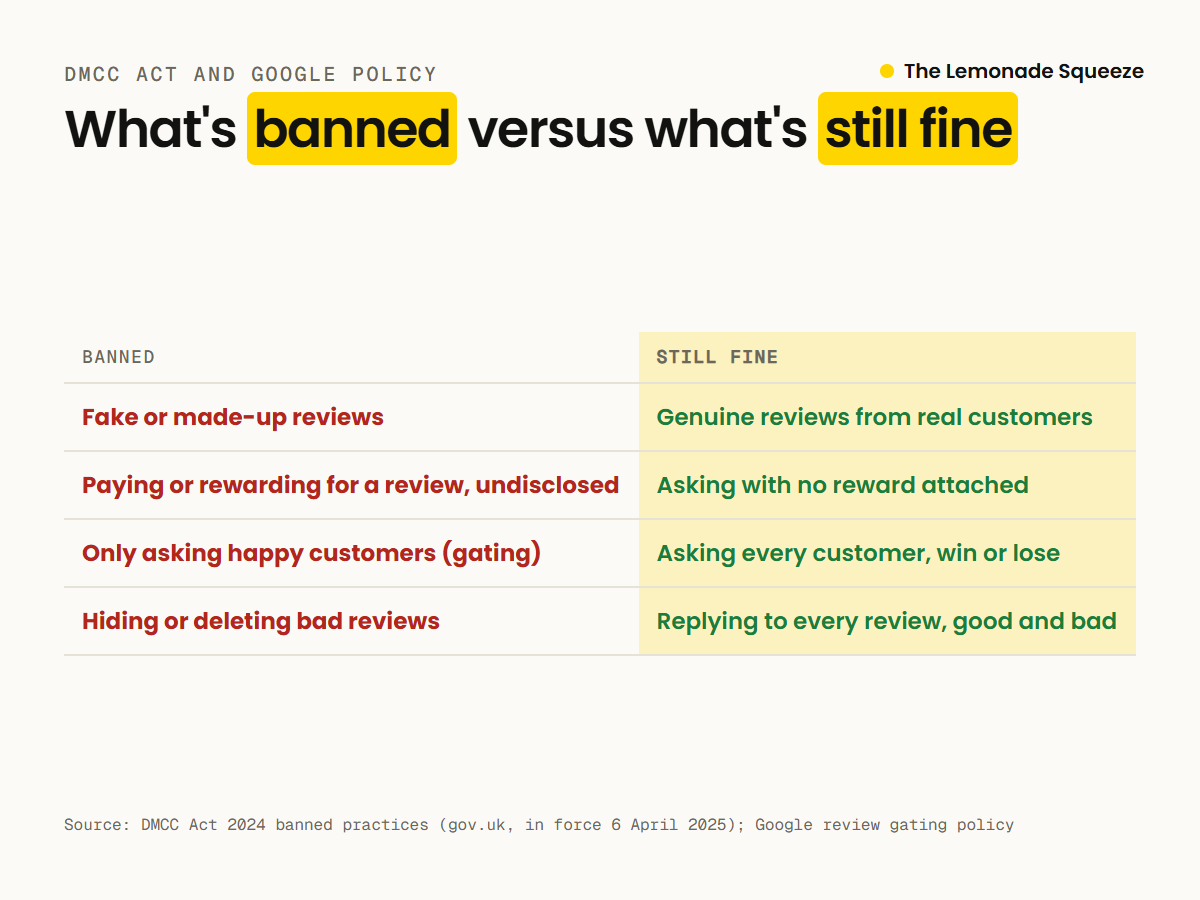
The banned practices are specific: submitting or commissioning a fake review that doesn't reflect a genuine experience, submitting or commissioning an incentivised review while hiding the incentive, publishing reviews in a misleading way (including showing only the positive ones), and not taking reasonable steps to catch and remove fake or undisclosed-incentive reviews on your own site.
None of that touches simply asking a real customer how their experience went. The CMA has already opened investigations under these rules: one case involves a business accused of offering discounts for five-star reviews without saying so, another involves allegedly withholding one-star reviews from publication. Fines for a confirmed breach can reach 10% of global turnover, so this isn't a toothless rule.
What's Still Completely Fine
Asking every customer, the same way, with no reward attached, is exactly what the law wants to see. At NB Physio, a clinic in Stafford, a straightforward ask sent to every patient took them from 13 Google reviews after a decade to 92 in one month, 73 of those in the first 14 days, with the rating holding at 4.9 throughout a free trial of ReviewSync.
Nothing about that process broke any rule, because nobody was paid, screened out, or steered.
The honest version of asking for reviews is exactly what both the law and Google want businesses to do, because it's the only version that produces reviews worth reading.
Can I Offer a Small Thank You?
This is the question that trips people up most. The DMCC Act doesn't ban every incentive for a genuine review, it bans hiding the incentive. If you tell customers upfront "leave any review, honest and unprompted, and we'll enter you into a monthly prize draw", that's disclosed and generally fine, because the reward isn't conditional on the review being positive and it's visible to anyone reading the review.
What tips it into banned territory is a reward tied to the rating, or a reward the reader of the review would never know existed. Offering a discount specifically for a five-star review, or quietly thanking staff who get a customer to leave one, both fail the test.
The safest version, and the one ReviewSync runs on, skips the question entirely: no reward of any kind, just a well-timed ask.
Where Businesses Actually Trip Up: Review Gating
Separately from UK law, Google has its own rule that catches businesses out more often: no "review gating". Google's policy bans discouraging or blocking negative reviews, or selectively soliciting positive ones, such as asking a member of staff to judge how happy a customer seemed before deciding whether to send the review link. Pressuring someone to review while they're still on the premises, or asking for specific wording or a named member of staff, is also against the rules.
The fix is simple: one review request, one link, sent to every customer regardless of how the job went. If a bad review turns up, reply to it properly instead of trying to make it disappear.
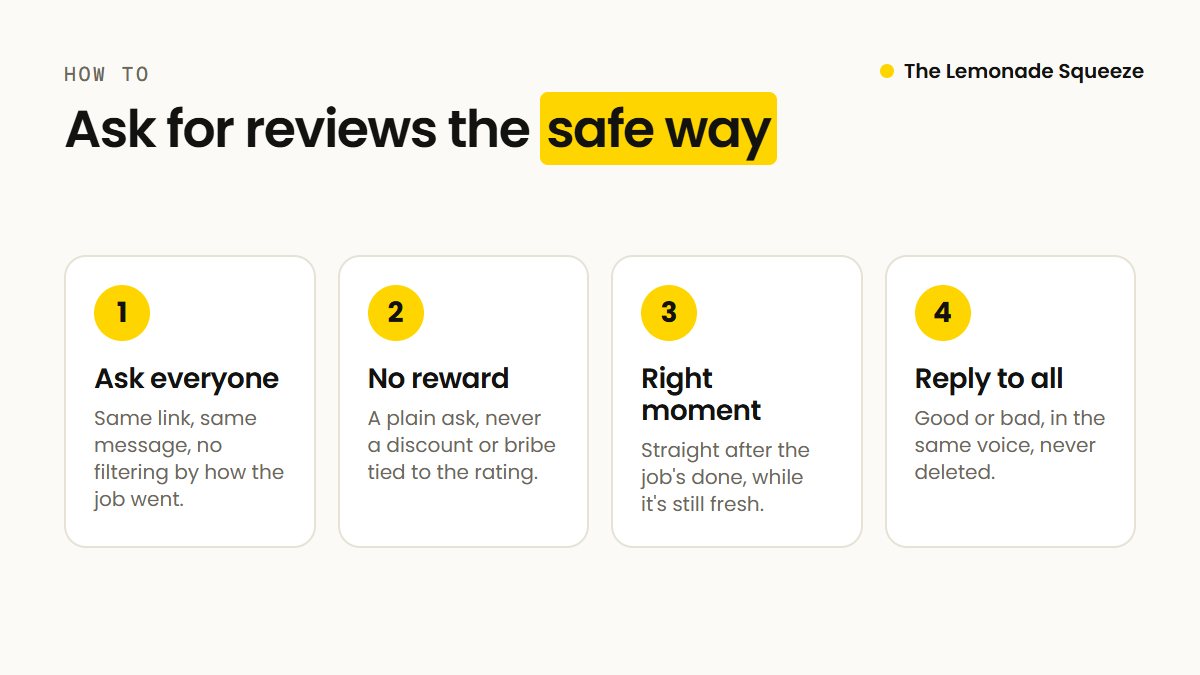
None of this needs software. A consistent habit, a plain message and the same link for everyone will keep you well inside both sets of rules. The only thing software buys you is remembering to do it every time, for every customer, without exception.
ReviewSync does exactly that. It sends the same honest ask to every customer at the right moment, and every review, good or bad, gets a reply. There's nothing in that process to explain to the CMA. 🍋