Off-The-Shelf or Bespoke: Which Software Is Right for You?
TL;DR
Buy off-the-shelf when the job is standard: payroll, basic accounting, email, calendars. Someone has already solved it well and cheaply.
Consider bespoke when the process is genuinely yours, the one that makes clients choose you over the business down the road, and no off-the-shelf tool fits it without heavy workarounds.
Compare subscription plus workarounds plus staff time against build plus hosting plus support, over three to five years, not just the headline subscription or build price.
A messy, constantly changing process is a reason to wait, not a reason to build. Bespoke work is easiest, and cheapest, once the process is settled.
You can mix both: buy for the commodity stuff, build (or wire together) for the one process that's actually yours.
The right answer depends on the one job in front of you. Off-the-shelf wins when a decent product already does what you need, cheaply and quickly. Bespoke earns its cost when the process is unusual enough, or valuable enough, that forcing it into someone else's software costs you more in workarounds than it would to build it properly.
Ask This First: Is the Process Standard or Is It Your Edge?
Before comparing prices, separate the job into two piles. Payroll, invoicing, email, scheduling, basic accounting: these are commodity processes. Every business needs them, nobody wins by doing them differently, and a mature off-the-shelf product will almost always beat a custom build on cost and reliability.
Then there's the process that's actually yours: the quoting logic only your estimator understands, the way you track a job from enquiry to invoice, the client portal that makes you look sharper than the next firm. If that process is why clients pick you, or if you're bending an off-the-shelf tool into shapes it was never built for, that's the candidate for bespoke.
What Off-The-Shelf Software Does Well (And Where It Breaks)

A good SaaS product is cheap to start, quick to set up, and improves without you lifting a finger. For straightforward jobs, that's hard to beat. Both of our own products are off-the-shelf tools for exactly this reason: ReviewSync for getting more Google reviews, FileFi for sharing files securely. Neither needs a development project, because asking happy customers for a review and sending a client a file securely aren't processes that need to be unique to your business.
Off-the-shelf starts to strain when your workflow doesn't match the product's assumptions. You end up with spreadsheets bolted on the side, a person whose whole job is copying data between systems, or a workaround so fragile that only one employee understands it. If you're already doing that, the "cheap" tool is quietly costing you in staff hours and risk.
What Bespoke Software Actually Costs (And What Drives It)
Bespoke costs more upfront than a subscription, and anyone who tells you otherwise is selling you something. What drives the price is scope (how many screens, how many integrations, how much logic), not hours typed at a keyboard. A small internal tool that replaces one spreadsheet is a very different job to a customer-facing app with logins, payments and reporting.
The way we run bespoke projects: a discovery fee that's credited against the build if you go ahead, working software you can see and use every sprint rather than a single reveal at the end, and no black-box development where you're told to trust the process. Catching a wrong assumption in week two is cheap. Catching it in month six is not, which is why that structure matters as much for cost control as it does for trust.
A SaaS subscription keeps billing every month. Bespoke software needs hosting and support once it's live. Neither option is a one-off cost, so compare the full three to five year picture on both sides, not just the sticker price.
A Simple Checklist to Decide
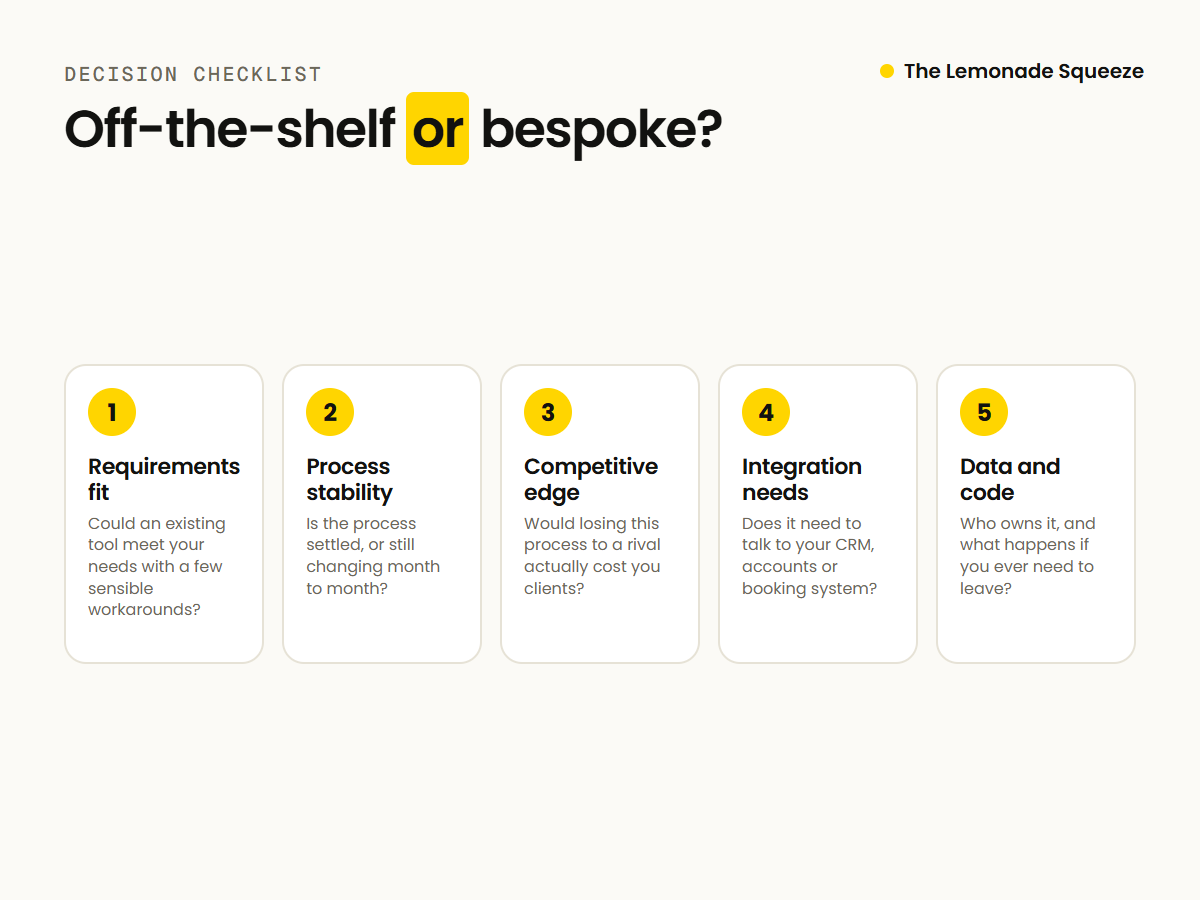
Could an honest list of your requirements be met by an existing tool, accepting a few sensible workarounds? If yes, lean off-the-shelf.
Is this process stable, or still changing month to month? A process that's still settling is a reason to wait on building it, not a reason to rush in.
Would losing this process to a competitor who does it better actually cost you clients? If yes, it's worth owning.
Does it need to talk to systems you already run (your CRM, accounts package, booking calendar)? That tips things towards custom, or at least a proper integration layer.
Who owns the result? With bespoke, you own the code. With off-the-shelf, check what you can export and what happens if you ever leave.
Most businesses end up doing both: buying the commodity tools and building, or carefully wiring together, the one process that's genuinely theirs. If you're stuck on which pile your process falls into, that conversation is free. 🍋