Is WeTransfer Safe for Client Files? UK Business Guide
TL;DR
WeTransfer's free plan caps you at 3GB a transfer, deletes the link within 3 days, and only tracks who downloaded a file if you switch that on before you send it.
Dropbox Business (£12 to £18 a user a month, read on dropbox.com, 6 November 2026) adds UK/EU hosting and audit logs, but only on "eligible" plans, and you're paying for a lot of storage just to send files securely.
Email still caps out around 20-25MB with most providers, and a read receipt is not proof anyone opened the attachment.
None of them were built to answer "where was this hosted, and who accessed it" by default. That's the question FileFi answers: UK data centres, a full audit trail on every file, no size limit, £22 a user a month.
Free tools are still fine for a quick, low-stakes file. The real question is whether what you're sending is actually low-stakes.
Short answer: WeTransfer is fine for sending a quick file to someone who won't mind where it's hosted or whether anyone's tracking it. For client contracts, financial records or anything with personal data in it, the free tier gives you no UK data residency and no standing audit trail. Its download tracking exists, but it's something you have to switch on before you hit send, not something that happens by default.
What "Safe" Actually Means for Client Files
Most file-sharing tools are encrypted in transit, so "is it encrypted" is rarely the real question a UK business needs answering. The questions that actually matter, especially if a client or an insurer ever asks, are narrower:
Size limits. Will the tool actually take the file, or make you compress it first?
Link expiry. Does the file stop being accessible when you want it to, or sit live indefinitely?
Who can see it was downloaded. If someone asks "did the client receive this, and when", can you answer with a timestamp, or a guess?
Where the data actually sits. "UK data residency" is a specific, checkable claim, not a vibe.
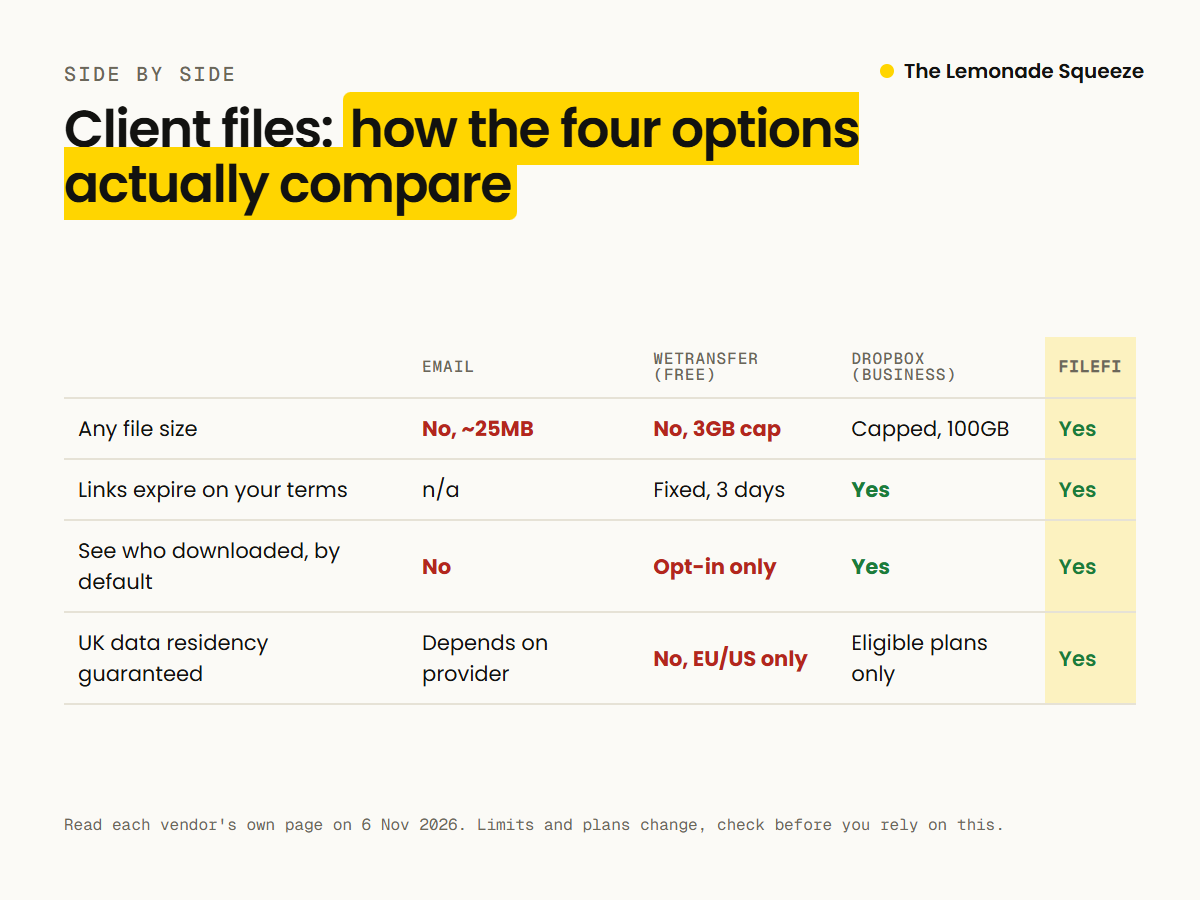
Judge every tool, including the free ones, against those four. Here's how the usual suspects stack up.
WeTransfer: Fine for Small Files, Risky for Sensitive Ones
The free plan gives you 3GB a transfer, capped at 10 transfers or 3GB total in any rolling 30 days, and the link expires within 3 days by default. Paid tiers lift the cap (Starter) or remove it altogether (Ultimate), and extend how long a link stays live.
Data location is the part worth reading twice. WeTransfer's own security page says a file uploaded from an EU IP address, without a proxy, is stored in the EU, currently on AWS infrastructure in Ireland. Upload from anywhere else and it's stored in the US. Its privacy policy also allows certain personal data to be processed by affiliates outside the EEA, under GDPR safeguards such as Standard Contractual Clauses. In plain English: WeTransfer does not promise your files, or the data about them, stay on UK or even EU soil. For a one-off holiday photo, nobody minds. For a client's financial records, that's the exact fact an auditor or a worried client will ask about.
Download tracking does exist, it's just opt-in. Turning on Access Control's "tracked downloads" before you send gets you a notification and a recipient-level download record. Leave it off, which is the default, and you get a basic "downloaded: yes/no" at best, with no reliable record of who.
Dropbox and Email Aren't Built for This Either
Dropbox Business starts at £12 a user a month (Standard, 3TB for the team) rising to £18 (Advanced, 15TB), both read on dropbox.com on 6 November 2026. It does offer UK or EU data residency, and audit logs that track file-level activity, which is more than WeTransfer promises. The catch is in the small print: residency is only available on "eligible" team plans, not guaranteed on every one, and Standard only keeps 180 days of activity history. You're also buying terabytes of team storage to get a file-sharing feature that's really a side benefit of a bigger product.
Plain email is the weakest option of the three. Gmail caps attachments at 25MB, and Microsoft's own guidance puts the standard internet email limit at 20MB, with Exchange accounts defaulting lower still unless an admin raises it. Beyond that, you're relying on a cloud link anyway. And whichever inbox it lands in, a read receipt only tells you the email was opened. It's not proof the attachment was downloaded, by whom, or when, and there's no audit trail to point to afterwards.

When FileFi Is Worth the Switch
If the file is sensitive, if "where was this hosted and who accessed it" is a question your client, your insurer, or your own conscience might ask, that's the point a dedicated tool earns its keep.
FileFi takes files of any size, runs on two UK data centres, encrypted at rest and in transit, and logs a full audit trail on every file by default, not as an opt-in extra. Links expire when you set them to.
It's £22 a user a month, with the founder code FOUNDER30 live until 1 December 2026, then FOUNDER20.
It's not the right tool for everything. A 10MB PDF to a contact you trust doesn't need any of this, and WeTransfer's free tier will do the job in thirty seconds.
The switch is worth making when what you're sending would actually cause a problem if it ended up somewhere you didn't choose, or if nobody could tell you when the client had it.
Most files your business sends don't need any of this. The ones that do are usually the ones that matter most. 🍋